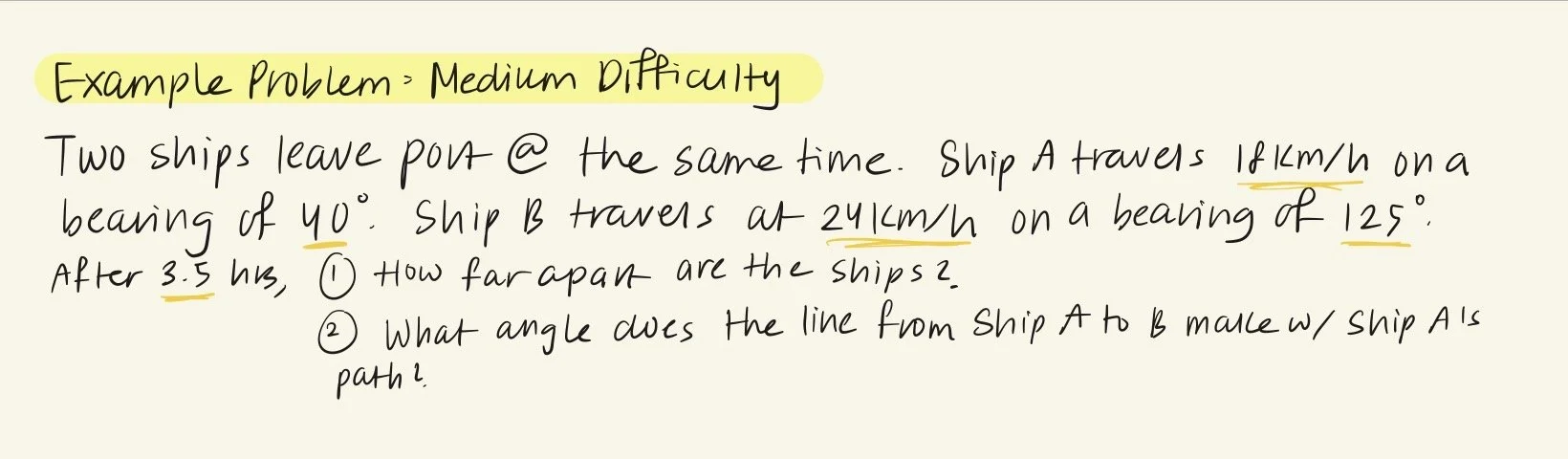
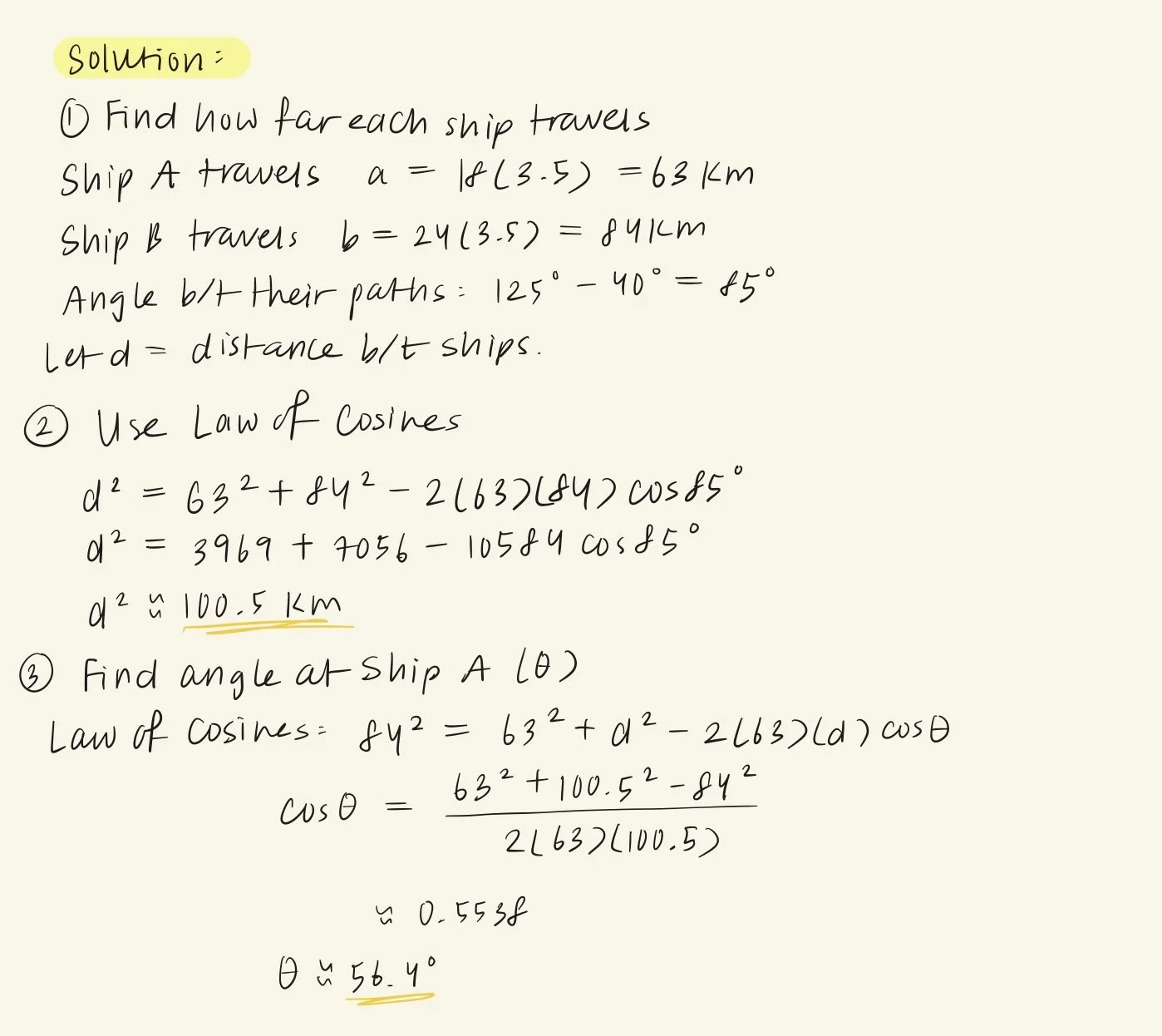
By now, you have familiarized yourself with SOHCAHTOA and how to calculate the angles and sides of a right triangle. Here I will introduce arguably more powerful tools that you can use to find the angles and sides of non-right triangles: the law of sines and the law of cosines.
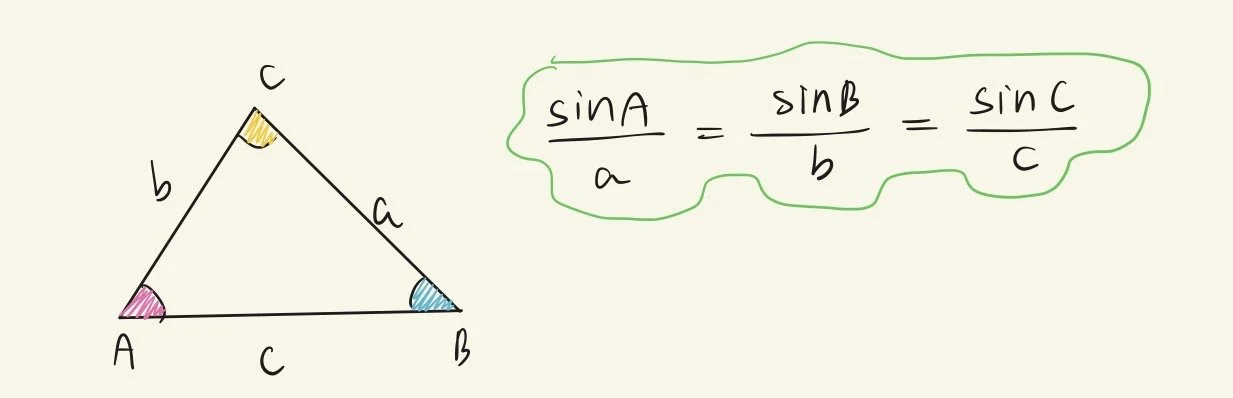
Law of Sines
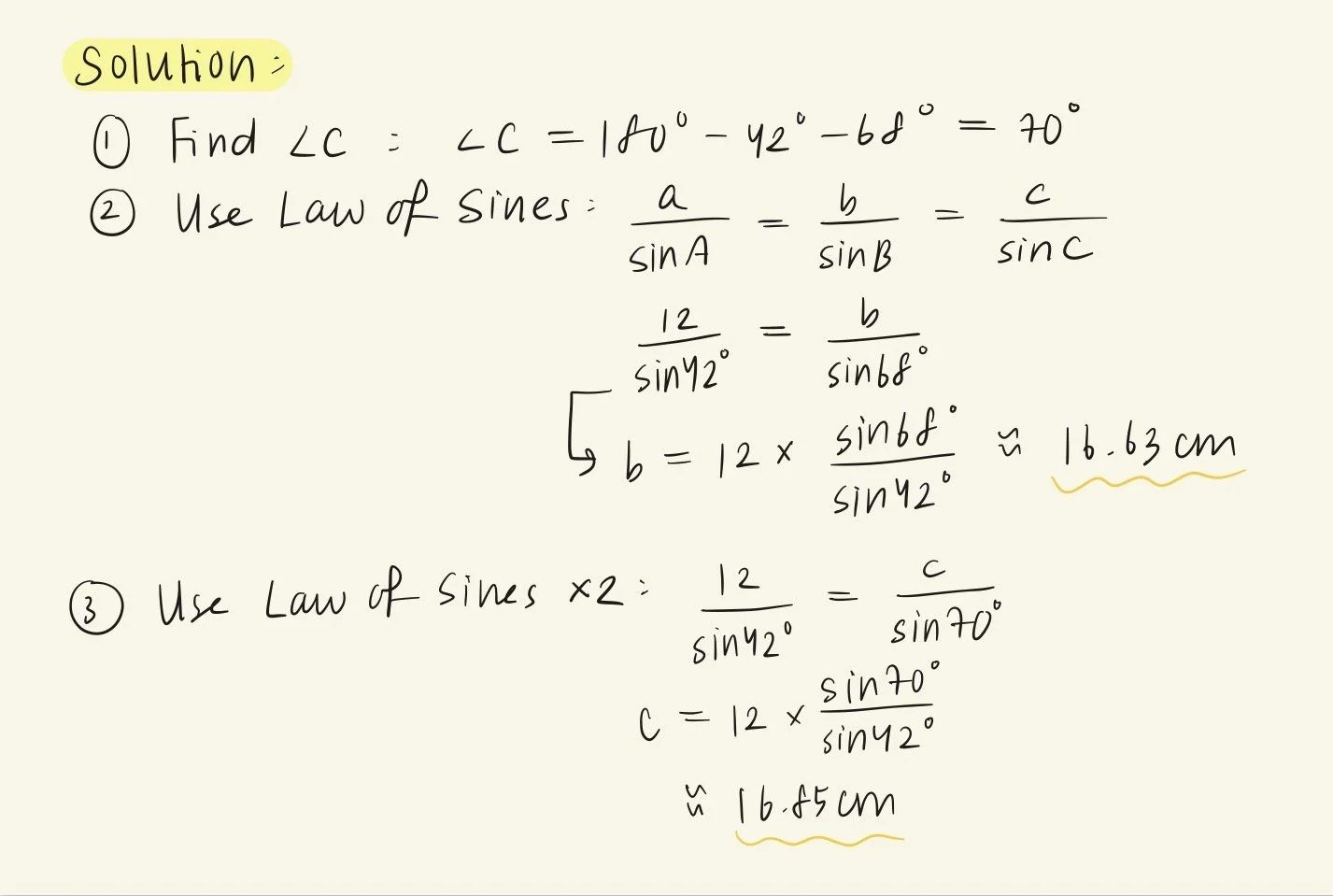
The Law of Sines draws a relationship between the angles and opposite sides of a triangle. It is used in the following cases: two angles and one side (AAS or ASA), or two sides and a non-included angle (SSA). Intuitively, larger angles face longer sides, and smaller angles face shorter sides. The Law of Sines quantifies the ratio between the angle corresponding to a side and the side itself. Solving questions involving the Law of Sines is easy as it’s only direct substitution. The tricky part is knowing when to use the Law of Sines versus the Law of Cosines, explained below.
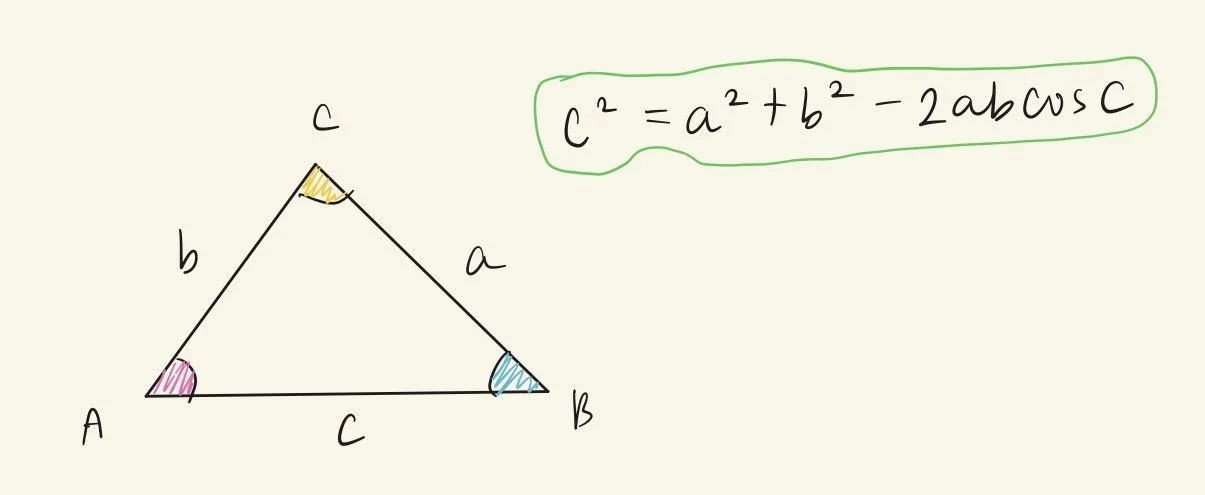
Law of Cosines
Examples
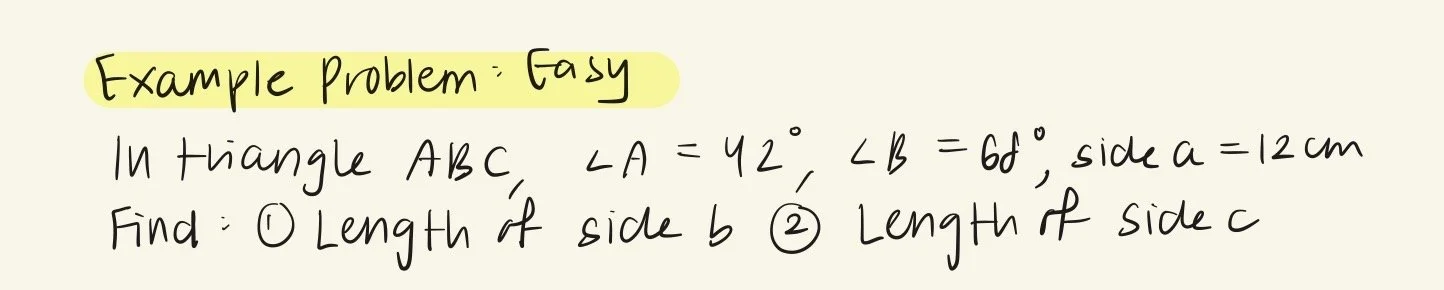
Law of Sines Worked Example
The Law of Cosines is an extension of the Pythagorean Theorem, which can only be used on right triangles. If the triangle is right, then cos(90°) = 0, so the formula becomes c² = a² + b². When this is not the case, however, we use the Law of Cosines. It is used in the following two cases: when the triangle is SAS or SSS. In other words, we are given two sides and their sandwiched angle, or all three sides.
Law of Cosines Worked Example