Fractals: A Quick Introduction
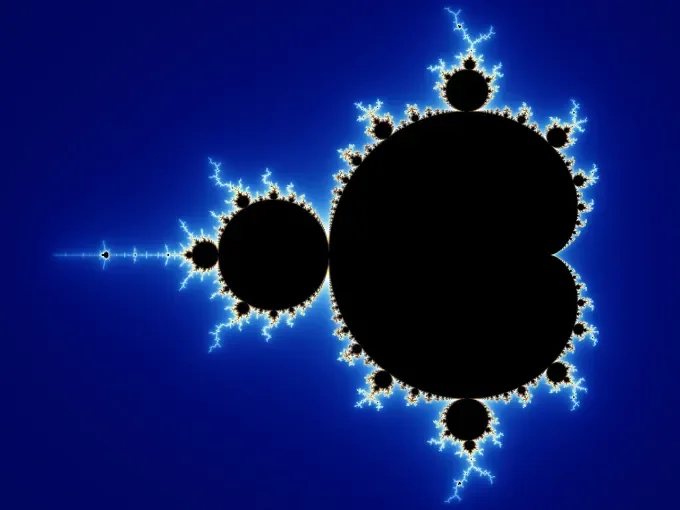
“Bottomless wonders spring from simple rules, which are repeated without end” — Benoît Mandelbrot
At first glance, a coastline, a snowflake, or a fern leaf may seem unrelated. Yet all of these natural objects share a remarkable property: they exhibit patterns that repeat at different scales. This phenomenon is known as fractality, and the mathematical structures that describe it are called fractals.
Fractals have fascinated mathematicians and scientists for decades because they reveal how simple rules can generate extraordinary complexity. From computer graphics and weather modeling to stock market analysis and medical imaging, fractals have become an important tool for understanding both nature and technology.
What Is a Fractal?
A fractal is a geometric shape that displays self-similarity, meaning its structure appears similar regardless of the scale at which it is viewed. If you zoom in on a small part of a fractal, you often find a pattern resembling the entire object.
Unlike traditional geometric figures such as circles, squares, and triangles, fractals can possess infinitely intricate detail. Their complexity arises from repeated application of simple mathematical rules. The term fractal was introduced in 1975 by mathematician Benoît Mandelbrot, who defined fractals as shapes whose dimensions are not necessarily whole numbers. This concept challenged classical geometry and opened a new field of mathematical exploration. The Mandelbrot fractal is displayed in the image above. It is generated by the simple recurrence equation, zₙ₊₁= zₙ² + c, where c is a complex number, z is the value being calculated.
One of the defining characteristics of a fractal is its fractal dimension. Traditional geometric objects have integer dimensions:
A line has dimension 1
A square has dimension 2
A cube has dimension 3
Fractals often have non-integer dimensions. For example, the famous Koch Snowflake has a dimension of approximately 1.26, indicating that it is more complex than a one-dimensional line but does not completely fill a two-dimensional plane. Many fractals are generated through iterative processes. Starting from a simple shape, a rule is repeatedly applied, creating increasingly detailed structures. Despite the simplicity of these rules, the resulting patterns can be astonishingly complex.
Examples of Fractals
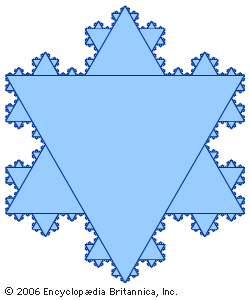
The Koch Snowflake
Created by Swedish mathematician Helge von Koch in 1904, the Koch Snowflake begins as an equilateral triangle. At each iteration, smaller triangles are added to each side. The perimeter grows infinitely long while the enclosed area remains finite.
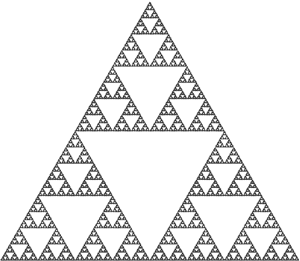
The Sierpiński Triangle
The Sierpiński Triangle is formed by repeatedly removing smaller triangles from a larger triangle. The resulting figure displays perfect self-similarity and serves as a classic example of recursive geometry.
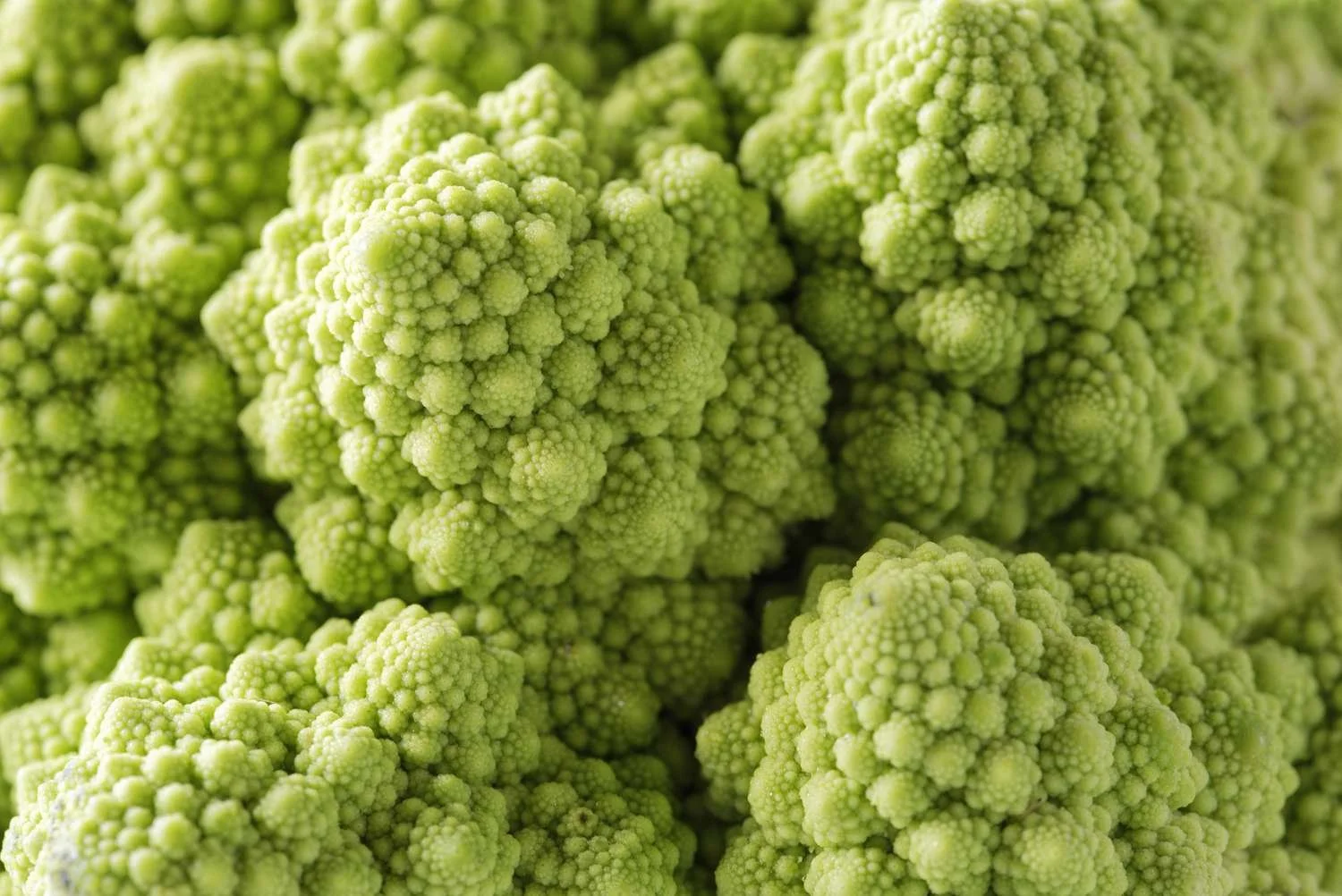
Cauliflowers - especially the Romanesco variety - form fractals because they are made of “failed flowers.” Instead of blooming, plant stem cells get stuck in a loop, continually trying to create flowers but only generating new stems, which repeat the pattern on smaller and smaller scales
Cathy Scola / Getty Images
Cauliflower!
Snowflakes
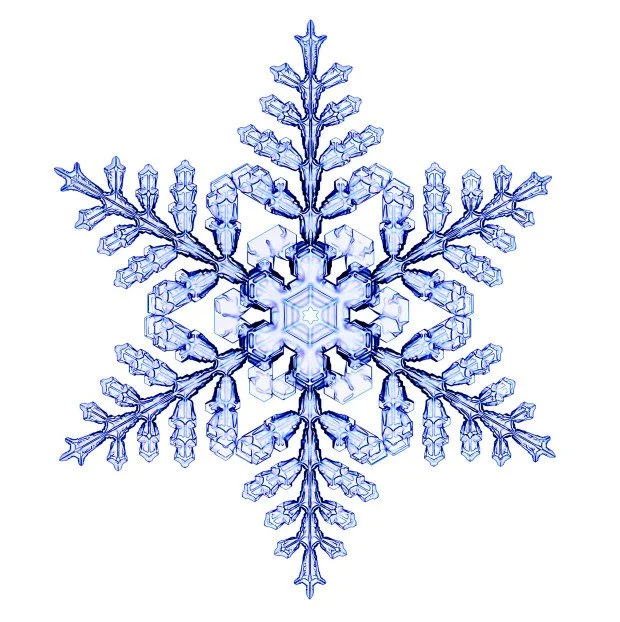
The growth of snow crystals follows physical processes that naturally create intricate fractal patterns. Each snowflake develops unique branching structures while maintaining overall symmetry.